Gucci High Watchmaking Enters a New Register of Craft
- DAAS2R

- Apr 14
- 4 min read

At the highest end of watchmaking, technical mastery alone is no longer the full story. Increasingly, what distinguishes a timepiece is the ability to unite mechanical sophistication with artistic depth, material rarity and a fully articulated point of view. With its sixth high watchmaking collection, Gucci moves decisively further into that territory, revealing a body of work that feels more refined, more expressive and, perhaps most notably, more confident in its own language of craft.
Presented during an intimate off-fair event at The Woodward to coincide with Watches and Wonders, the new collection signals a meaningful evolution in Gucci’s horological ambition. It is not only an expansion of the house’s high watchmaking universe, but a deeper commitment to métiers d’art as a serious and central dimension of its identity. In doing so, Gucci also appears to be speaking more directly to a collector increasingly attentive to emotion, artistry and nuance, including a female audience long underserved by the codes of traditional high watchmaking.
At the centre of this new chapter is the continued development of the G-Timeless line, first introduced in 2021 with Gucci’s inaugural high watchmaking collection. For this latest edition, the family welcomes new additions to the Métiers d’Art range, a category that allows the house to translate its archival imagination into an altogether more intricate horological form.
The collection draws deeply from the Gucci archive, revisiting emblematic visual languages that have long shaped the house’s aesthetic identity. Nature, wildlife and movement recur throughout, expressed through highly specialised techniques including miniature painting, featherwork and enamelling. These are not decorative gestures, but acts of interpretation, transforming archival motifs into richly layered objects that sit somewhere between timepiece and miniature tableau.
Four new Métiers d’Art watches, each housed in a 40mm case on alligator strap and featuring a tourbillon at 12 o’clock, take their inspiration from some of Gucci’s most resonant scarf designs, from Vittorio Accornero’s iconic Flora of 1966 to the Animalia motifs of the late 1970s and further visual codes introduced in the 1980s. The result is a collection steeped in house memory, yet rendered with a contemporary sense of texture, light and dimensionality.
Two of the new pieces explore the Animalia theme through a collaboration with French feather artist Nelly Saunier, whose work is known for its extraordinary precision and its use of feathers collected only during birds’ natural molting. In both timepieces, featherwork becomes a medium of remarkable subtlety, lending the dials an almost cinematic softness and movement.
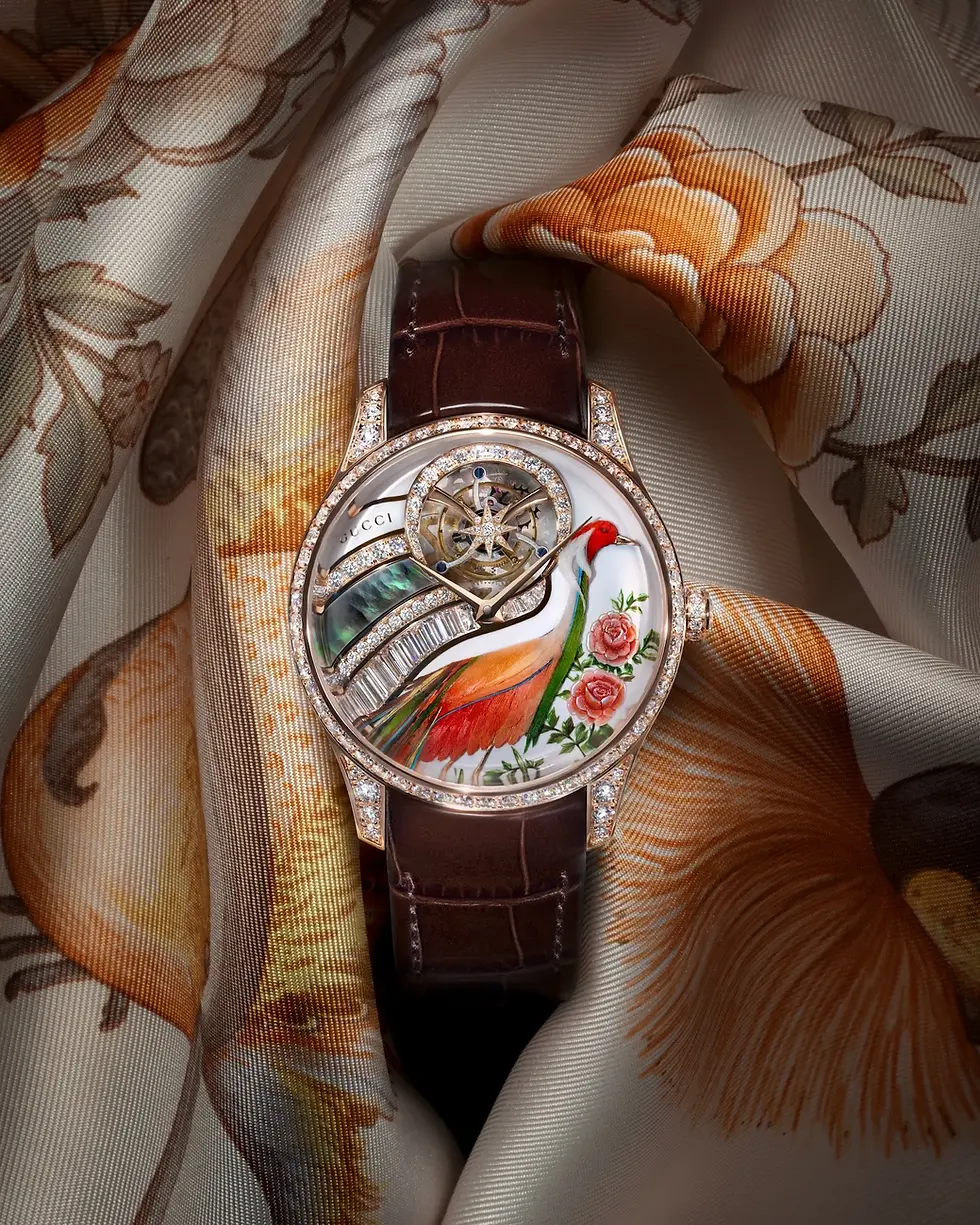
The first, offered in rose gold, features a crane outlined in gold and filled with feathers against a white grand feu enamel dial. The composition is enriched by sinuous lines of baguette- and brilliant-cut diamonds, interspersed with mother-of-pearl inlays, while engraved blooming flowers in mother-of-pearl are further elevated through micro painting. The effect is both ornamental and exacting, delicate in appearance yet extraordinarily complex in execution.
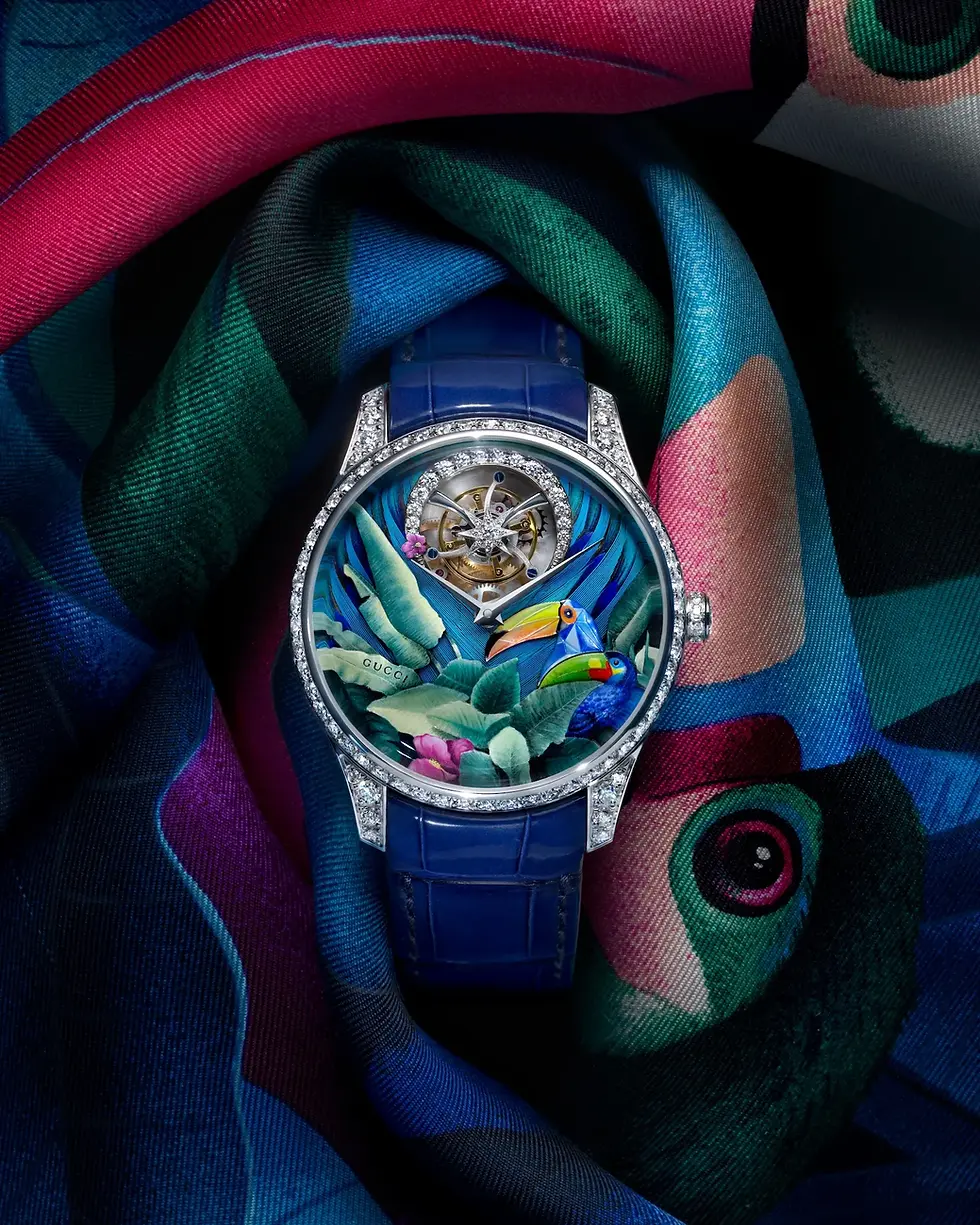
Its white gold counterpart takes on a cooler, more chromatic register. Here, a mother-of-pearl dial is overlaid with feathers in graduated shades of blue, shifting from aquamarine to deep navy to form the backdrop for a toucan and verdant foliage rendered in engraved and overpainted mother-of-pearl. At 12 o’clock, the tourbillon is accented with a tiny fuchsia flower, introducing a flash of unexpected colour into an otherwise tonal composition.

A third wildlife-inspired watch nods directly to Gucci’s late-1970s Animalia motif. Framed in rose gold with a knurled bezel, it presents a mother-of-pearl dial animated by a hand-painted rose gold tiger emerging from dense foliage, accompanied by a hand-engraved bamboo stem and set against a micro-painted milky sky that evokes the softened light of sunset. The piece captures something Gucci has long done distinctively well: a sense of narrative glamour, suspended between fantasy and precision.

The fourth G-Timeless Métiers d’Art watch turns to perhaps the house’s most iconic visual signature: Flora. Executed on a white gold base clad in onyx, the dial is inlaid with pink opals, blood jaspers, miniature-painted details and hand-engraved mother-of-pearl to recreate the black version of Gucci’s celebrated floral motif. A tiny grasshopper and dragonfly, rendered in micro-painted and engraved white gold, introduce a note of wit and intricacy, while diamonds on the bezel and lugs echo the diamond-set frame surrounding the tourbillon. It is a piece that feels at once intensely ornamental and rigorously composed.
Alongside these highly expressive Métiers d’Art creations, Gucci also continues the evolution of its 25H line. Since its debut in 2021, the Gucci 25H has become central to the house’s modern watchmaking vocabulary, particularly through the introduction of its exclusive calibre. Now, the family expands with a new 40mm interpretation of its 8.4mm-thin case, reworked with a more slender case frame and rendered in a precious, high-impact version set with rainbow-coloured baguette sapphires across the open-worked dial. The stones illuminate and frame the skeletonised movement within, bringing a jewelled exuberance to one of Gucci’s most architecturally disciplined silhouettes.
What makes this sixth high watchmaking collection especially compelling is not only the complexity of its execution, but the clarity of its intention. Gucci is no longer simply participating in high watchmaking; it is shaping a more expressive space within it, one where craftsmanship is allowed to be emotional, decorative, archival and technically serious at once.
In that sense, this collection feels less like an extension and more like a statement. One that suggests Gucci understands something essential about the future of contemporary horology: that the most resonant watches will not be those defined by mechanics alone, but those capable of transforming time into culture, craft and character.
