When Fashion Becomes Art: Schiaparelli at the V&A
- DAAS2R

- Apr 14
- 4 min read

Fashion is often dismissed as transient: seasonal, commercial, seductively unstable. Art, by contrast, is granted permanence, seriousness and the privilege of endurance. Elsa Schiaparelli belonged to the rare category of creators who made that distinction feel suddenly inadequate. With her, fashion did not merely borrow from art or flirt with it aesthetically. It entered into a far more radical exchange, becoming a site where Surrealist ideas could be worn, inhabited and brought vividly into daily life.
That singular cultural moment is now the focus of “Schiaparelli: Fashion Becomes Art” at London’s Victoria & Albert Museum, the first exhibition in the U.K. dedicated to the house and its founder. Opening at a moment when the relationship between fashion, image and cultural authorship feels newly charged, the exhibition reframes Schiaparelli not simply as an inventive couturière, but as a central protagonist in a broader artistic constellation.
What emerges is not the familiar story of fashion seeking legitimacy through proximity to art. It is something more interesting: the portrait of a designer who was already embedded in the intellectual and visual life of her time, and who understood, earlier than most, that clothing could carry wit, provocation, symbolism and psychological charge with the same force as painting, sculpture or photography.

Working in the fraught years between the two world wars, Schiaparelli transformed the codes of dress at a moment when Europe itself was being culturally and emotionally reconfigured. Aristocratic, intellectually curious and unusually attuned to both science and art, she built a fashion language that was at once disobedient and precise. Instead of reinforcing conventional ideas of beauty, she unsettled them. Instead of using couture to idealise, she used it to animate, distort, provoke and delight.
Her collaborations with artists including Salvador Dalí, Jean Cocteau and Alberto Giacometti remain among the most compelling examples of what can happen when fashion is treated not as surface, but as a serious creative medium. The now-iconic Skeleton dress from 1938, embroidered with raised ribcage bones across black silk crepe, remains one of the clearest expressions of that exchange. It is not merely a garment inspired by Surrealism, but the material trace of a genuine conversation between designer and artist, one in which image, body and fantasy were actively reimagined.
The same can be said of the Lobster dress, co-created with Dalí, or the Tears dress, with its illusion of violently torn fabric, or the irreverent shoe hat that remains one of the great acts of fashion wit in the twentieth century. These pieces endure because they do more than shock. They reveal a designer capable of translating avant-garde thought into objects of wearability, seduction and lasting visual memory.

That may be what continues to make Schiaparelli feel so contemporary. She was not simply adjacent to artists; she operationalised artistic thinking through dress. Trompe-l’oeil knitwear, utilitarian zippers on evening gowns, buttons transformed into miniature sculptures, experimental textiles such as cellophane and woven glass, practical innovations in sportswear and swimwear: all of it points to a mind unwilling to separate fantasy from function. Her work was cerebral, but never inert. It moved, lived, performed.
The exhibition’s power lies in showing how fully Schiaparelli inhabited this in-between space. With more than 400 objects on display, including fashion, artworks, jewellery, photography, furniture, perfume and archival material, the V&A constructs not only a retrospective, but a world. It suggests that Schiaparelli’s genius was not limited to silhouette or decoration, but extended to image-making itself, to the construction of a total visual and cultural language.
That idea feels especially resonant today. In an era shaped by digital visibility, brand mythology and the speed of image circulation, Schiaparelli appears strikingly ahead of her time. Her self-promotional instincts, her instinct for spectacle, her understanding of fashion as a medium of attention and identity all anticipate the contemporary logic of cultural visibility. Yet what separates her from so much of what followed is depth. Her work sought attention, certainly, but it also rewarded scrutiny.
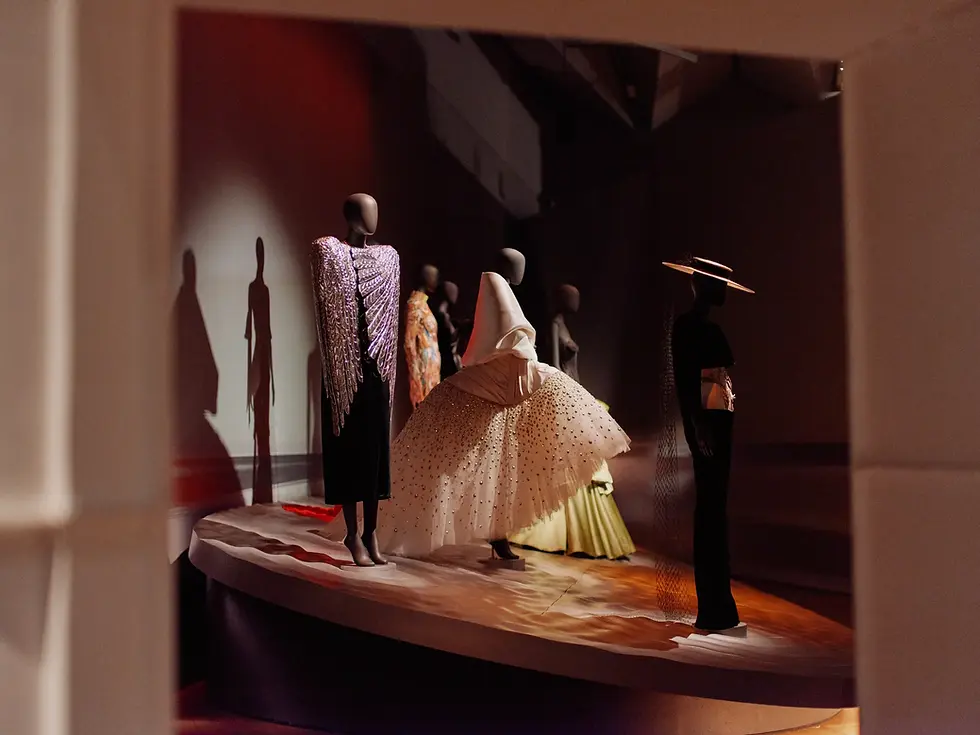
That duality remains central to the house’s enduring appeal under creative director Daniel Roseberry, whose designs appear in the exhibition’s final room. Roseberry has often understood that Schiaparelli’s legacy is not one of fixed codes, but of permission: permission to be theatrical, intelligent, provocative, exacting and emotionally legible all at once. The house’s current relevance lies precisely there, not in nostalgia, but in activation.
And that may be the exhibition’s most important insight. Schiaparelli does not matter because she was eccentric, surreal or ahead of her time, though she was all of those things. She matters because she understood something that still feels urgent: that fashion, at its most powerful, is never merely decorative. It is a way of thinking. A way of seeing. A way of making ideas visible on the body.
“Schiaparelli: Fashion Becomes Art” ultimately argues that the boundary between art and fashion was never as fixed as culture preferred to imagine. In Elsa Schiaparelli’s hands, it dissolved into something rarer and more enduring: clothing with intellect, image with bite, and beauty sharpened by imagination.